


EAMCET 2027 Exam Pattern & Syllabus: What Students Actually Need to Know

Confused about the EAMCET 2027 exam pattern and syllabus? A clear, honest breakdown of what the exam really tests — and where most students go wrong — from Spark Academy, Hyderabad.

A few years ago, one of our students — let's call him Sai — walked into class three months before EAMCET convinced he was going to fail Maths. He wasn't weak at it, really. He'd just decided, somewhere along the way, that Physics "made more sense" to him, so that's where all his energy went. By the time we sat him down and actually looked at the exam pattern with him, his face changed. Half the paper was Maths. Half. He'd been pouring hours into 25% of his score and starving the biggest chunk of it.
He's an engineer now. But I still think about how much earlier he could've gotten there if someone had shown him this one page sooner.
That's really the point of this post. Not another generic "syllabus overview," but the stuff we wish every student saw before, not after, they build their study plan.
What the EAMCET Exam Pattern Actually Looks Like
EAMCET (Engineering, Agriculture and Medical Common Entrance Test) is run separately by Telangana and Andhra Pradesh for engineering, pharmacy, and agriculture-related admissions. If you're in Class 12 science right now, it probably feels like it's looming over everything — every conversation with relatives somehow circles back to it. That pressure is real, and honestly, it's okay to feel it.
Here's what the exam itself looks like, stripped of the drama: it's computer-based, three hours long, 160 questions, all multiple choice. And there's no negative marking. None. Which means every time you leave an answer blank because you're "not sure enough," you're choosing zero over a chance. A guess, even a rough one, beats a blank space every single time.

The 80 questions nobody talks about enough
I'll say it plainly because Sai's story keeps repeating itself with new names every year: Mathematics is 80 of the 160 questions. Physics and Chemistry are 40 each. Half the exam — literally half — comes down to Maths.
And yet, semester after semester, we see students quietly avoid it. Not because they can't do it, but because it takes more patience, more practice, more sitting-with-a-problem-until-it-clicks. If that's you right now, I'm not going to tell you Maths is easy. It isn't always. But it's where your rank is hiding, so it deserves your best hours, not your leftover ones.

What to actually spend your evenings on
You're not being asked to learn something new here — EAMCET pulls almost entirely from your Class 11 and 12 syllabus, leaning heavier on Class 12. So really, this is about where to put your weight.
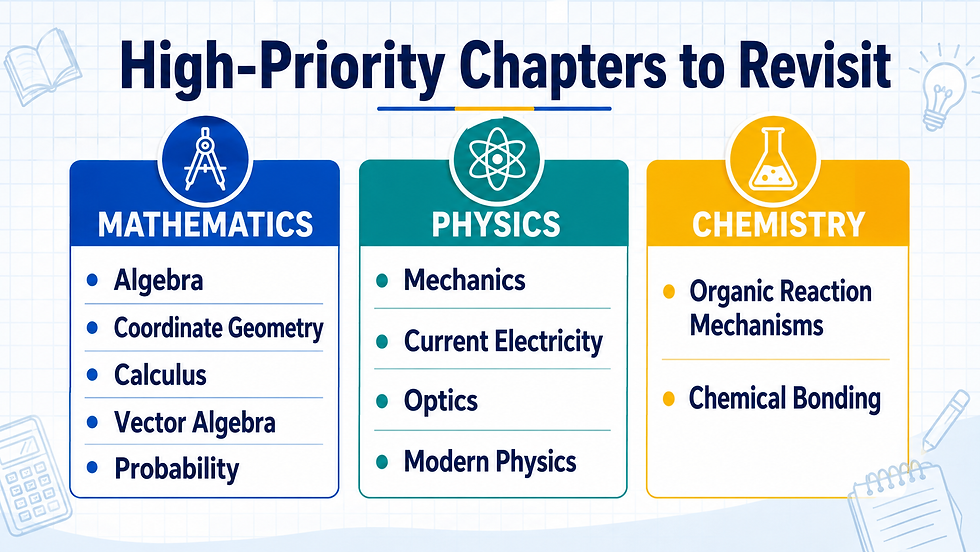
In Maths, Algebra, Coordinate Geometry, Calculus, Vector Algebra, and Probability show up again and again — treat them like old friends you revisit often.
In Physics, don't let Mechanics, Current Electricity, Optics, or Modern Physics slide to "I'll do it later."
And in Chemistry, Organic reaction mechanisms and Chemical Bonding have a habit of showing up right when you thought you were done with them.
The small habits that quietly cost students marks
None of what I'm about to say is about intelligence. I want to be clear on that. These are just patterns we see, over and over:
Students skip NCERT basics because they feel "too easy," and then get caught off guard when a question tests exactly that basic concept in a slightly unfamiliar way. They avoid timed practice until the last month, so when 67 seconds per question becomes a real, ticking constraint, it rattles them mid-exam — not because they didn't know the answer, but because the clock got inside their head. They skip previous years' papers, even though EAMCET has a habit of circling back to familiar territory. And they leave questions blank, still, even after knowing there's no penalty for guessing.
Fixable. All of it. Just not always obvious until someone points it out.
What we try to do differently
At Spark Academy, across our Mehdipatnam, Narayanguda, and Secunderabad centres, this is exactly what we build our EAMCET batches around. We don't march through the syllabus in the order the textbook lays it out — we start with what actually carries weight in the exam.
We run full-length mock tests often enough that the pressure of the real day stops being unfamiliar. And every so often, we sit down with a student one-on-one, look at where their marks are actually slipping, chapter by chapter, and just... talk it through. The way we did with Sai.

Frequently Asked Questions
Is there negative marking in EAMCET?
No. EAMCET has no negative marking, so every question deserves an attempt — even an educated guess is better than leaving it blank.
Which subject carries the most weightage in EAMCET?
Mathematics carries the highest weightage with 80 of the 160 questions in the Engineering stream — literally half the paper. Physics and Chemistry make up 40 questions each.
Is the EAMCET syllabus different from the Class 11 and 12 syllabus?
Not really. EAMCET draws almost entirely from the Intermediate (Class 11 and 12) syllabus, with a heavier emphasis on Class 12 concepts, so there's nothing extra to learn from scratch.
How many questions can I expect in EAMCET, and how much time do I get?
The EAMCET paper has 160 multiple-choice questions to be completed in 3 hours, which works out to roughly 67 seconds per question — a pace worth practising well before exam day.
One last thing
If you take nothing else from this — know where your marks live. Attempt every question, even the ones you're unsure of. And please, don't let Maths sit in the corner of your study table gathering dust.
If you want an honest, outside look at where you currently stand, walk into your nearest Spark Academy branch for a diagnostic assessment. Sometimes it takes someone else looking at your preparation to see what you can't see from inside it.
Spark Academy's EAMCET 2027 batches are built around exactly what's covered above — structured timelines, weekly mock tests, and one-on-one doubt support.
📞 Book a free demo class today — WhatsApp us at 8977525461 or 9133380172


Comments